Listing every dining-room dish on a delivery menu wastes the line on food that cannot finish during service, and on plates that fail the trip to the guest. Unilever Food Solutions says a compact delivery menu is easier to run, ties up less ingredient stock, and turns out faster (profitable-menu section of its food delivery checklist, page saved 11 October 2026).
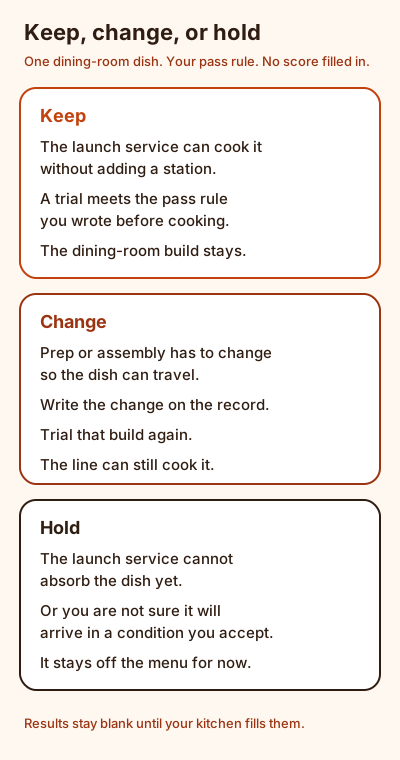
Keep a dining-room dish when the launch service can cook it and a trial order meets the pass rule you wrote first. Change it when the build needs a different prep or assembly so it can travel. Hold it when the line cannot take it yet, or when you are not yet sure it will arrive in a condition you accept.
Write that pass rule before anyone cooks the trial. Fill one blank record per dish. Recheck the filled record before the dish is offered to guests. Channel price math sits on the delivery versus dine-in pricing worksheet. This page chooses the dishes.
Which dishes do you keep, change, or hold?
Use one row per dish. The two limits are the launch service and the trip. A dish you already trust in the dining room can still be a hold on opening night if the line cannot cook it, and a dish that travels well can still be a hold for the same reason.
| Decision | Kitchen load | How it travels | What you do |
|---|---|---|---|
| Keep | The launch service can cook it without adding a station | A trial meets the pass rule you wrote before cooking | Leave the dining-room build on the delivery menu |
| Change | The line can cook a revised build | Prep or assembly has to change so the dish can travel | Write the change on the record and trial that build |
| Hold | The launch service cannot absorb it yet, or the trip is still uncertain | You are not sure it will arrive in a condition you accept | Leave it off the delivery menu until a later trial |
DoorDash’s merchant guide says to consider transport before you add a dish, and to leave the dish off for now if you are uncertain it will arrive in good condition (setup article dated 29 September 2026, text captured 11 October 2026). That is a hold. The same article’s soft launch limits the menu to dishes you already trust. Trust here means a trial you have judged, and the guide does not name a cuisine that travels better than another.
A change is a different build of a dish you can still cook. Unilever Food Solutions describes three changes in its food-quality notes: pack pasta just under the dining-room doneness, pack dressings and sauces on the side, and offer a heat-at-home version, with lasagna as its example, so the kitchen can hand the dish off earlier in the day. If you use a heat-at-home build, follow the labeling your local authority requires. The checklist points operators to local FDA guidance for meals finished off-site, including any required temperature, use-by, and reheat instructions. This page does not state those rules.
Your pass rule is the only score. Write it on the record before cooking. A dish passes only when every line you marked required meets the condition you wrote. A miss on a required line means change or hold. Lines worth marking, when they matter for that dish, are a matching ticket, parts that stayed apart, and a texture you would still serve. The arrival line records what you see. Time and temperature limits stay with your health authority.
Takeaway: Keep, change, or hold each dining-room dish on kitchen load and a trial against your own pass rule.
What do you write on the trial record?
One record, one dish. Copy the rows, leave the entry column blank, and fill it in your kitchen. The blank form is the trial. This page has no sample result and no guest story.
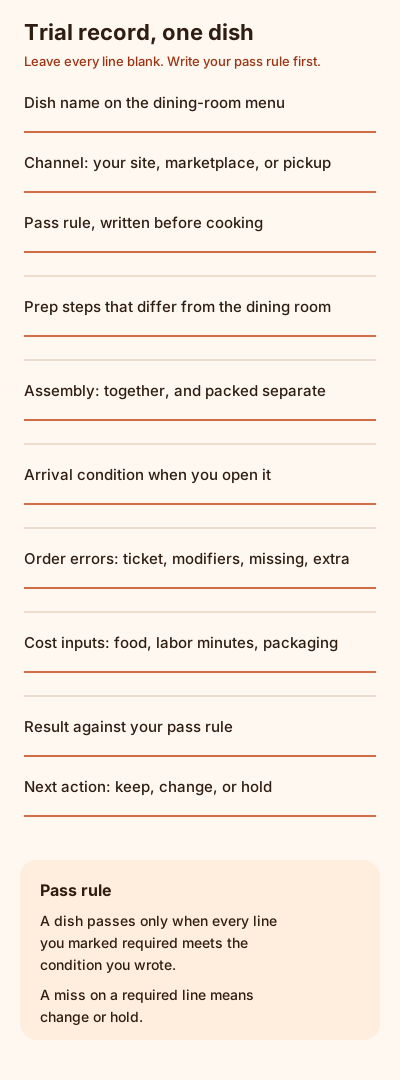
| Line | What you write | Entry |
|---|---|---|
| Dish | Name on the dining-room menu | |
| Channel | Your site, a marketplace, or pickup | |
| Pass rule | The condition you accept, written before cooking | |
| Prep steps | Steps that differ from the dining-room method | |
| Assembly | What is packed together, and what is separate | |
| Arrival condition | What you see when you open the order | |
| Order errors | Ticket, modifiers, missing items, extra items | |
| Cost inputs | Food, labor minutes, packaging you already buy | |
| Result | Pass or miss against your rule | |
| Next action | Keep, change, or hold |
Prep steps are the cook that changed, such as stopping pasta earlier than the dining-room plate. Assembly is the pack-out: sauce in the dish, or sauce on the side. Arrival condition is what you see when you open the container. Write moisture, separation, and texture in your own words. Do not turn that note into a temperature pass.
Order errors are a different line from food condition. Unilever Food Solutions says someone should check the order before it leaves, and that a phoned order should be read back to the guest. DoorDash’s pilot is also where tablet or POS problems show up, before a guest sees them. On the record, note whether the ticket fired, whether modifiers matched, and whether anything was missing or extra. Leave those cells empty until the trial. A missing item the guest reports after the order has left is a later record: log the channel, the missing line, and any remedy already issued on the missing takeout items response.
Cost inputs are food, labor minutes, and the packaging you already buy for that dish. They feed the price later. They do not set the price. After a dish is a keep, use the pricing worksheet for commission, packaging, and the contribution you want. Container choice is a separate decision. Record the pack you already use, and do not shop for a packaging supplier on this page.
Common mistake: Treating a guest-experience audit, or a single system test order, as the keep-or-hold decision. Mitti publishes a home-delivery mystery shopper checklist described on its public page as an end-to-end guest check. The template file was not opened, so this page does not list its fields. Toast’s first-order step checks that an approval method and an auto-firing device are set. That is the ticket path. The dish decision is the record above.
Takeaway: Fill prep, assembly, arrival, order errors, and cost inputs for one dish, and judge them only against the pass rule you wrote first.
What should the trial watch on the trip?
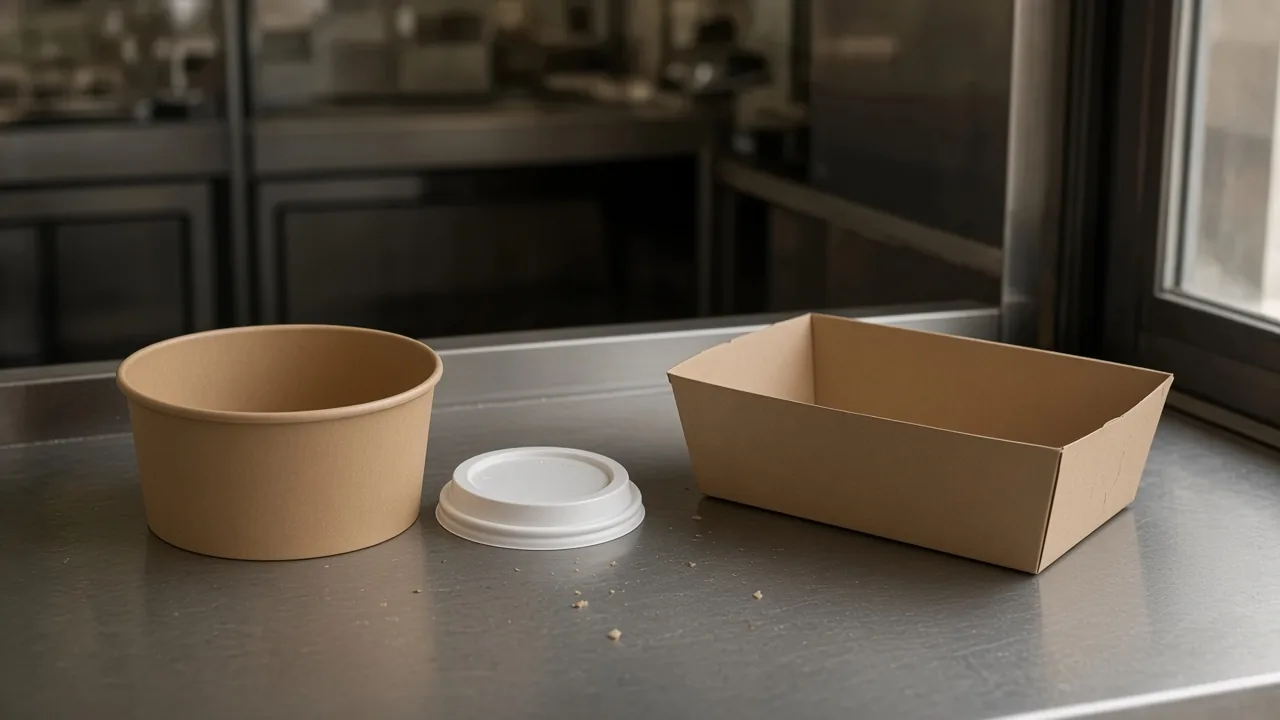
The dining-room plate and the closed container are the two states the trial compares. Cook the dish, pack it as you would for a real handoff, and open it under the same conditions you expect for that channel. Write what you see on the arrival line. The photograph below is an illustration of those two states. It is not an order from a named restaurant, and it is not a measured arrival test.
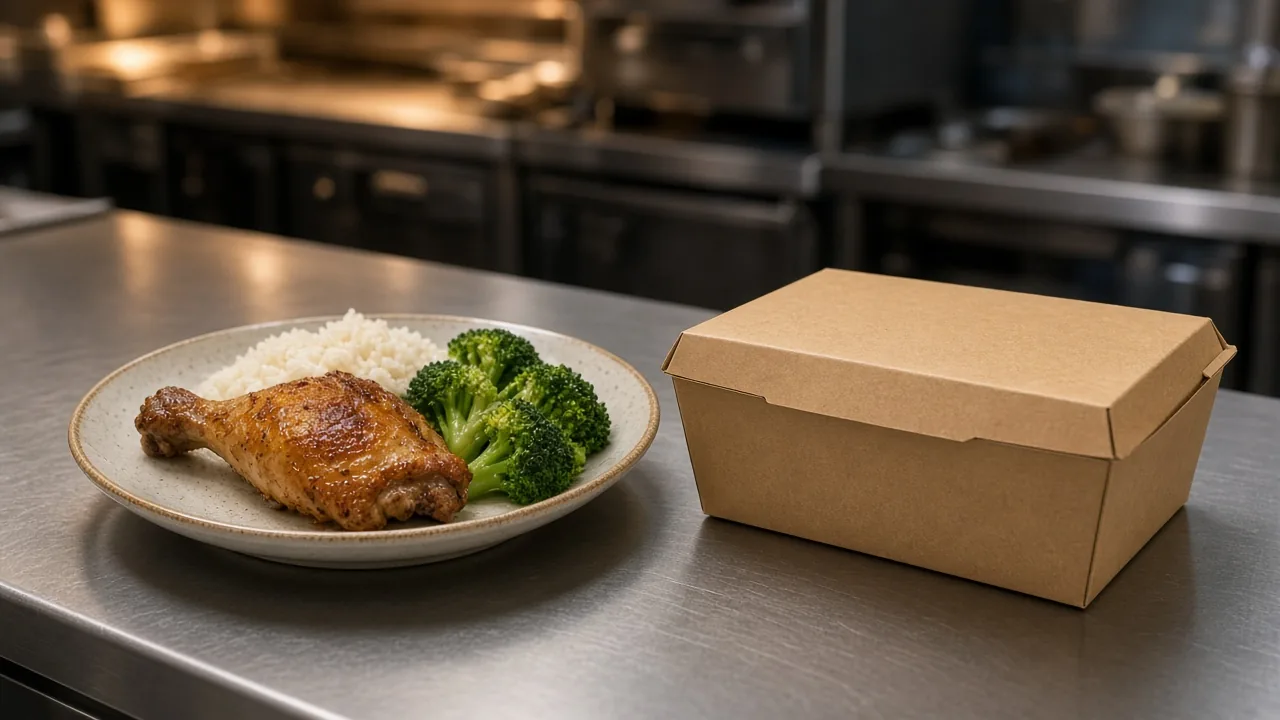
Unilever Food Solutions asks two food-quality questions before you offer a dish: whether it still works if the guest reheats it, and whether a bumpy ride will compromise the result you want. Use those questions to choose what the arrival line must capture. A ride that leaves the dish short of your rule is a change if a prep or assembly edit can fix it, and a hold if you do not yet have an edit you will stand behind.
Kitchen load is the other watch, and it is independent of the plate. A compact list is the profitable-menu point from the same checklist: fewer dishes, less stock, faster turn-out. If adding the dish means a new station or a slower dining room during the launch window, mark hold even when a quiet test trip looked acceptable. Toast, in Step 5 of its online-ordering launch checklist, says to turn ordering on during a slower day, such as a Tuesday or Wednesday, and to delay or snooze orders while you ramp (page rechecked 12 October 2026; the article’s own stamp is 17 September 2026).
The same keep, change, or hold record is the delivery menu testing checklist whether the order is on your site or on a marketplace. Delivery operations collects the channel pages. How DoorDash, Uber Eats, and pickup differ as businesses is the delivery apps guide.
Takeaway: Watch arrival against your rule, and hold any dish the launch service cannot cook without slowing the room.
How do you choose on DoorDash or Uber Eats?
DoorDash’s setup guide tells a restaurant to soft-launch before opening to the full customer base: pull the delivery radius back, limit the menu to dishes you already trust, and run a few test orders yourself. Use that pilot to confirm prep-time estimates, whether your current packaging leaves the food in the condition you want after transit, whether the tablet or POS mis-handles the ticket, and whether the pickup area has a gap. When that path runs smoothly from kitchen to door, the guide says to expand the radius and restore the fuller menu. Restore a held dish only after its own record passes your rule.
A direct request for that DoorDash page returned HTTP 403 on 12 October 2026, as it did on 11 October. The steps above are from the article text captured on 11 October 2026. Re-read the live guide before you copy a DoorDash click-path, because this page could not re-open it today.
Uber Eats appears in the way operators phrase this task. The sources read for this page do not include an Uber Eats per-dish admission rule. Use the same record if you list there, and read Uber’s current merchant menu instructions on Uber’s site before you publish. Do not borrow DoorDash’s soft-launch clicks as if they were Uber’s.
Takeaway: On DoorDash, trial a short list and check travel, POS, and pickup before you widen the radius. On Uber Eats, use the same dish record and Uber’s own menu steps.
What do you recheck before the dish goes live?
Go live with the dishes whose records pass, on a service the line can carry. The recheck is a second look at the same rule. It is not a new score invented here.
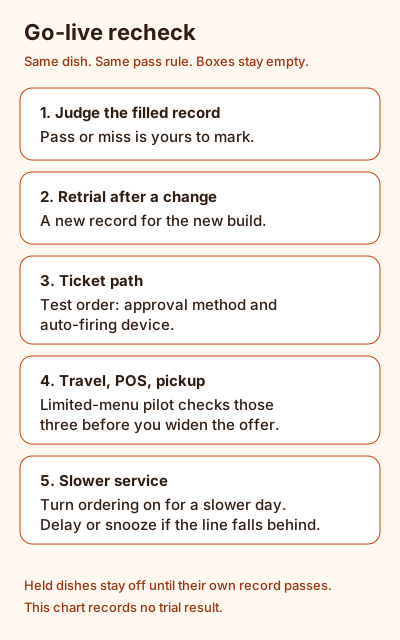
| Step | Recheck | Done when |
|---|---|---|
| 1 | Read the trial against the pass rule you wrote | You have marked pass or miss yourself |
| 2 | If you changed the dish, fill a new record for that build | The new record is the one you judge |
| 3 | Place a test order on the ordering system | Approval and auto-fire match what Toast describes for a first order |
| 4 | Limited-menu pilot | You have checked travel, the tablet or POS, and the pickup area |
| 5 | Service load | Ordering is on for a slower day, and you can delay or snooze if the line falls behind |
| 6 | Widen the offer | Radius and held dishes stay limited until each added dish has a passing record |
Step 3 is Toast’s test order, rechecked live on 12 October 2026. Step 4 is DoorDash’s pilot list: travel, POS, and pickup. Step 5 is Toast’s slower-day start, plus delay or snooze while volume climbs. Step 6 is this page’s rule on top of DoorDash’s instruction to restore the fuller menu only after the kitchen-to-door path is smooth: a held dish stays off until its own record passes.
Then price a kept dish on the worksheet. More restaurant operations writing is on the blog.
Takeaway: Offer the dish after its record passes your rule, the ticket fires, and the launch service can carry it.
When this does not apply
- Packaging supply. This page records the pack you already use. It does not choose a container or a supplier.
- Best-dish lists. Keep, change, and hold are judgments about your line and your trial. They are not a ranking of cuisines or of fried food against braises, bowls, or any other category.
- Time and temperature rules. Write what you see on arrival. Food-safety times, temperatures, and labeling stay with your health authority. The Unilever checklist only points at local FDA guidance for heat-at-home meals. It is not quoted here as a standard.
- Alcohol. This page does not add drinks and does not encourage anyone to drink. Permits stay with your state and local authority.
- Channel price math. Commission, pickup-price conditions, and contribution per order are on the pricing worksheet, read from US merchant cards dated in that article.
- Outside this reading. Toast’s Step 5 was rechecked on 12 October 2026. DoorDash and Unilever Food Solutions returned HTTP 403 to a direct refetch that day, so their steps are from the 11 October 2026 captures. Platform screens change.
Takeaway: Use the matrix for dish admission, and leave containers, fees, alcohol, and food-safety rulings to their own sources.
How we checked this
We compiled this guide on 12 October 2026. Toast’s online-ordering launch checklist was fetched live that day. Step 5 still says to start on a slower day, place a test order so the approval method and auto-firing device are set, and delay or snooze orders while ramping. The page stamp on Toast’s article is 17 September 2026.
DoorDash’s “How to Set Up Delivery for Your Restaurant in 5 Simple Steps” is dated 29 September 2026 on the captured page. A direct fetch returned HTTP 403 on 11 October and again on 12 October. The limited-menu trial, the travel, POS, and pickup checks, and the instruction to leave a dish off when arrival is uncertain come from the text captured on 11 October 2026. Cuisine examples in that article are not used. The margin paragraph in the same stretch is left to the pricing worksheet.
Unilever Food Solutions’ delivery checklist was saved on 11 October 2026. Its HTML datePublished field reads 1 October 2026. A direct refetch on 12 October 2026 returned HTTP 403. This page uses the profitable-menu, operations, and food-quality sections only. The older COVID safety and policy block, drink specials, and container sizes are not used.
Mitti’s public page, saved 11 October 2026, describes a home-delivery mystery shopper checklist as an end-to-end guest check. The template was not downloaded, so no internal field list is claimed. We ran no kitchen trial and we invented no result. About states who publishes this independent site.
Takeaway: Treat the platform steps as dated readings, and treat every trial line as a blank your kitchen fills.
Related reading
- Delivery vs dine-in menu pricing worksheet. Price a dish after you decide to keep it.
- Restaurant delivery apps: types, fees, and how they make money. See who takes the order and who delivers it.