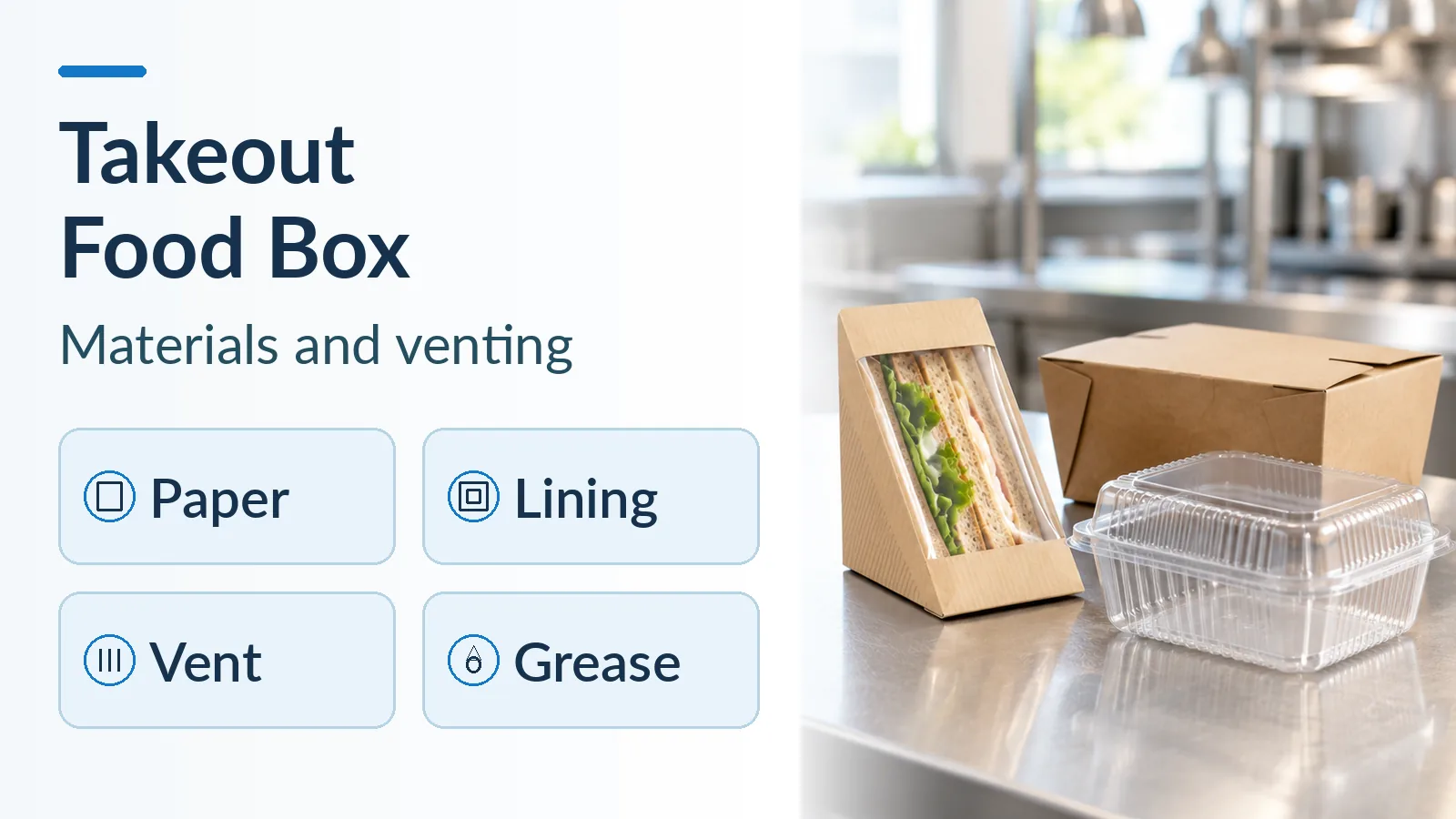
A takeout food box that leaks grease or returns condensation to a crisp crust can turn a completed meal into a remake. Choose its material and grease barrier for the dish, then choose venting for the texture you want: crisp food needs a steam escape route, while steamed or saucy food needs moisture and liquid managed separately.
Choose a takeout food box as a complete construction: substrate, lining, closure and vent path. Start with what would spoil the order—soft crust, wet cardboard, escaped sauce or a lid pressed against the food—then compare candidate packs with the same portion and bag arrangement. Paperboard, fluted fiber and polypropylene describe the structure; they do not tell you everything about the lining or lid. This guide separates those decisions, gives a simple clearance calculation, and shows what to record before adding a pack to routine service. Use the exact product specification and a dish-specific journey check to make the final choice.
What should you record before choosing a box?
Record the dish’s moisture, free liquid, portion shape and intended journey before comparing materials. These inputs belong alongside the box description in your delivery operations records.
| Input or item | Typical value or source | Why it matters |
|---|---|---|
| Desired arrival texture | Your dish specification: crisp, moist or sauce-coated | Establishes whether escaping steam helps the dish |
| Grease and free sauce | Actual recipe and filled portion | A grease barrier and a liquid-retaining closure solve different problems |
| Substrate and lining | Exact manufacturer’s product description | A fiber pack may have a separate lining |
| Lid and vent arrangement | Product drawing and physical sample | Check how it closes and where vapor can leave |
| Food and closed-lid heights | Measurements of the filled candidate pack | Exterior catalogue dimensions cannot establish inner clearance |
| Packing and journey conditions | Actual bag, stack, pickup wait and route | A box on a counter does not reproduce a packed order |
Keep the channel recorded too. The restaurant delivery apps guide explains how pickup, marketplace delivery and other channels differ; use the handling conditions of the channel you actually operate.
How do the main material constructions compare?
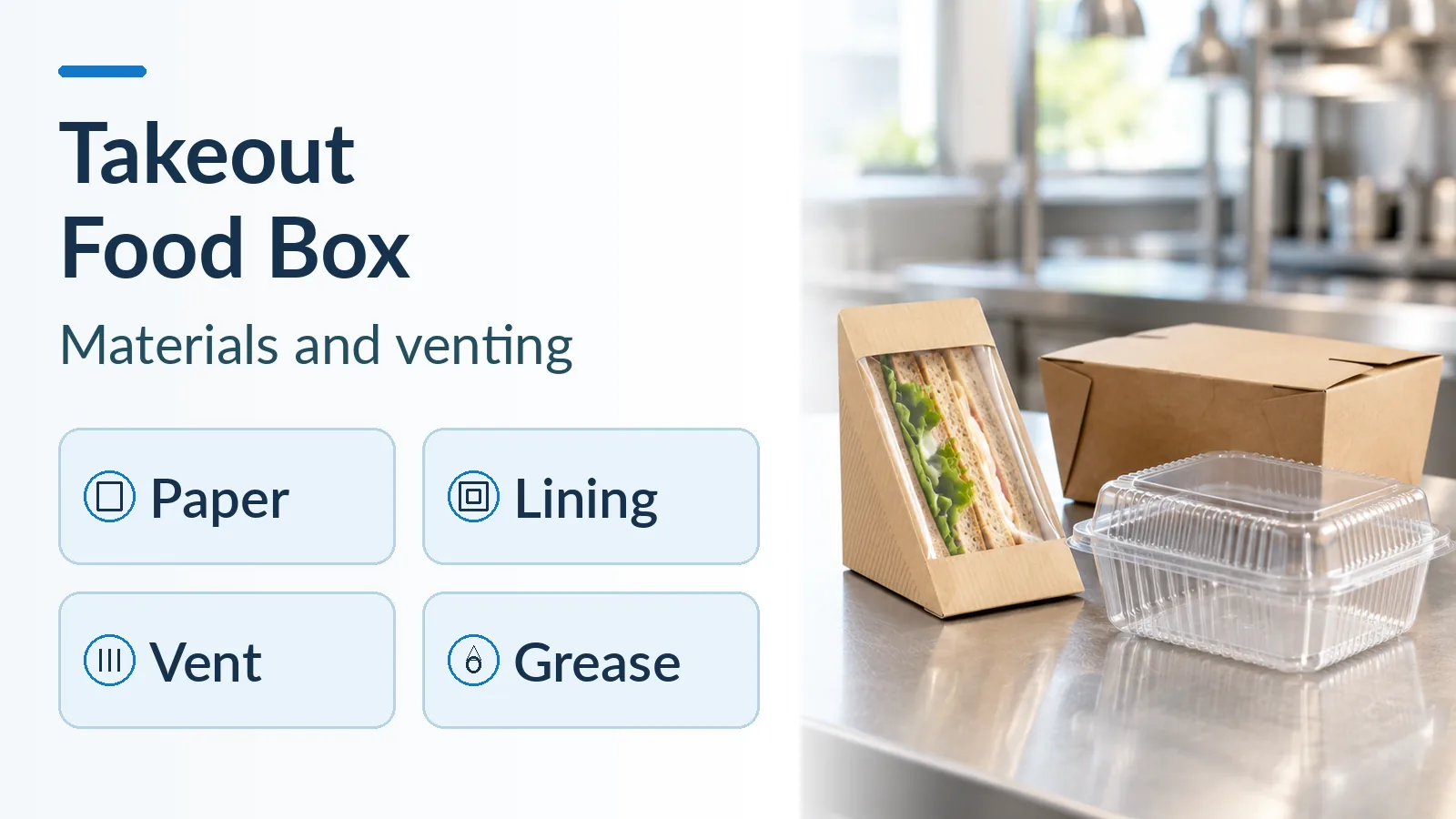
Compare the finished pack rather than choosing by color or the word “paper.” Huhtamaki’s Taste range describes both fluted packs with a grease-resistant lining and a hot box with PET lining. Those are specific constructions, rather than properties of all fiber packaging. (Huhtamaki, Taste range, accessed October 19, 2026.)
Genpak’s PV205A product page identifies polypropylene as the material and describes a clear vented top. That example shows why resin and vent configuration belong in separate fields. (Genpak, PV205A, accessed October 19, 2026.)
The following are candidate configurations and checks, not universal performance ratings.
| Construction | Candidate use to evaluate | What to verify on the exact pack | Dominant Failure Mode & Prevention |
|---|---|---|---|
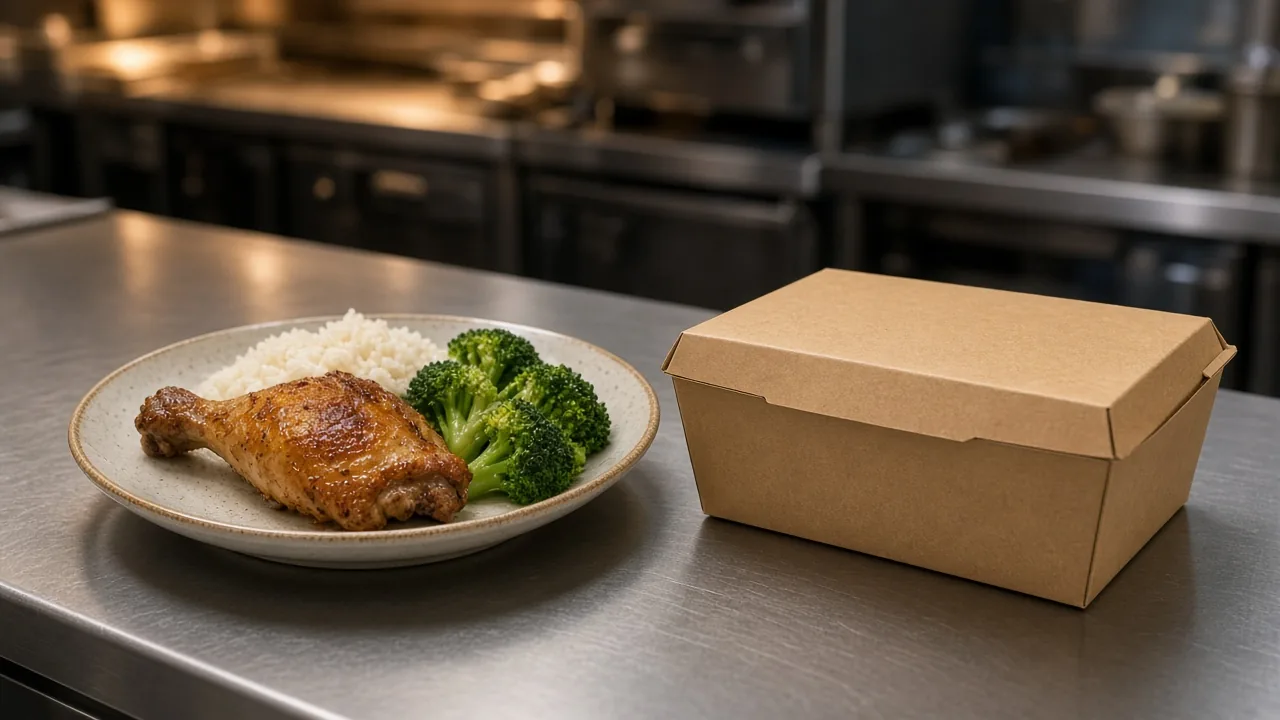
| Lined paperboard box | A greasy main dish with contained sauce | Lining, folded corners, closure and filled shape | Watch corners and exposed edges for wetting or escape; choose the barrier and construction that pass the filled journey check |
| Fluted fiber pack with grease-resistant lining | A hot sandwich or crisp component | Lining coverage, food clearance and designed openings | Watch for food compressed against the lid or moisture trapped in the pack; preserve clearance and the intended vent route |
| Polypropylene box with a vented lid | A hot meal with a crisp component | Vent position, lid engagement and stack compatibility | Watch for a blocked vent or an incompletely closed rim; keep openings clear and check the whole closure |
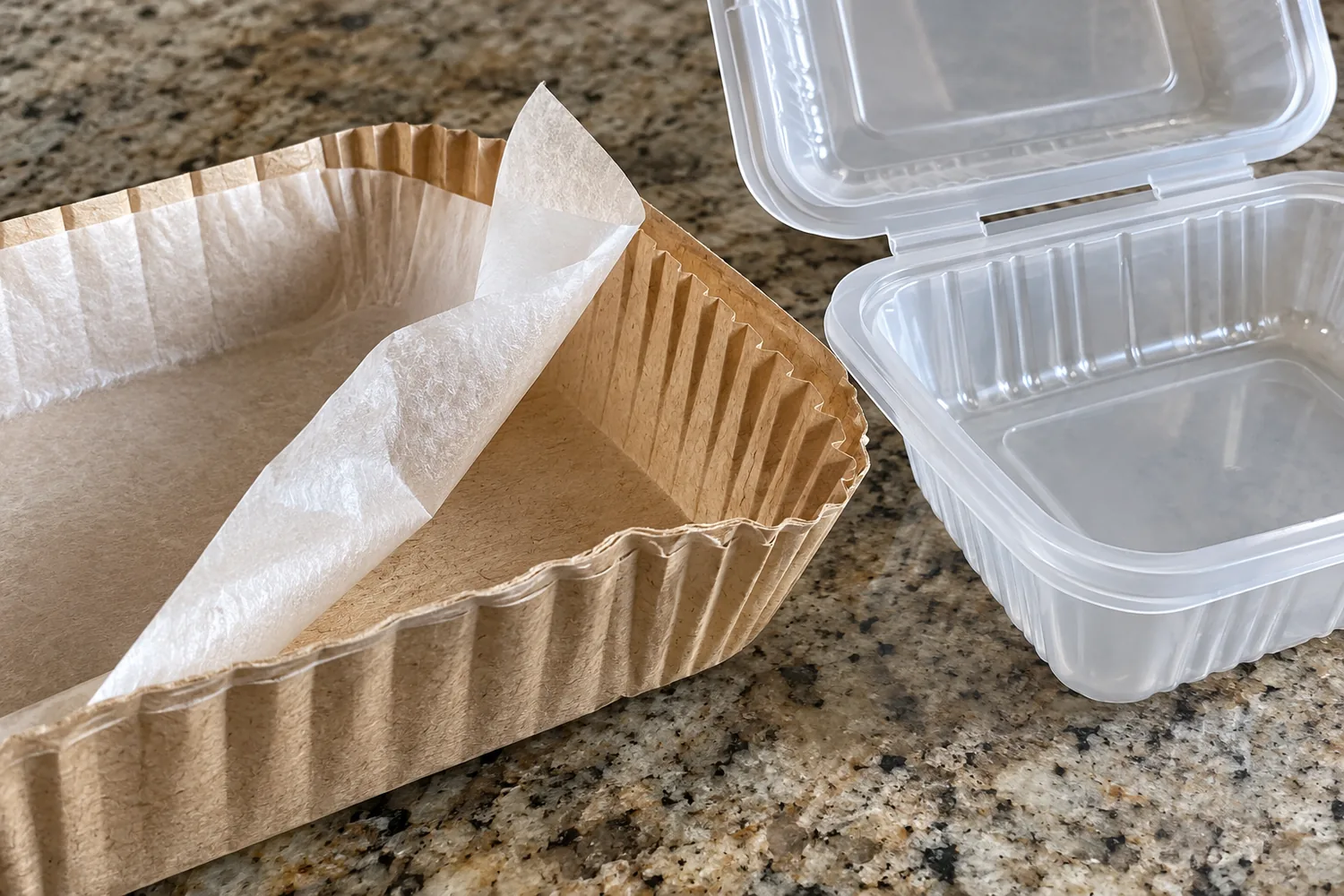
A brown surface does not identify the lining, and a clear lid does not identify its material. Record base and lid separately. A temperature or appliance claim must apply to the exact combination; the material names above do not establish one.
When does venting help hot food?
Venting helps when released moisture would damage the desired texture. Genpak explains that lid openings let steam escape and that condensation inside a closed pack can collect on fried or grilled food. (Genpak, Why Vented Food Packaging Matters, accessed October 19, 2026.)
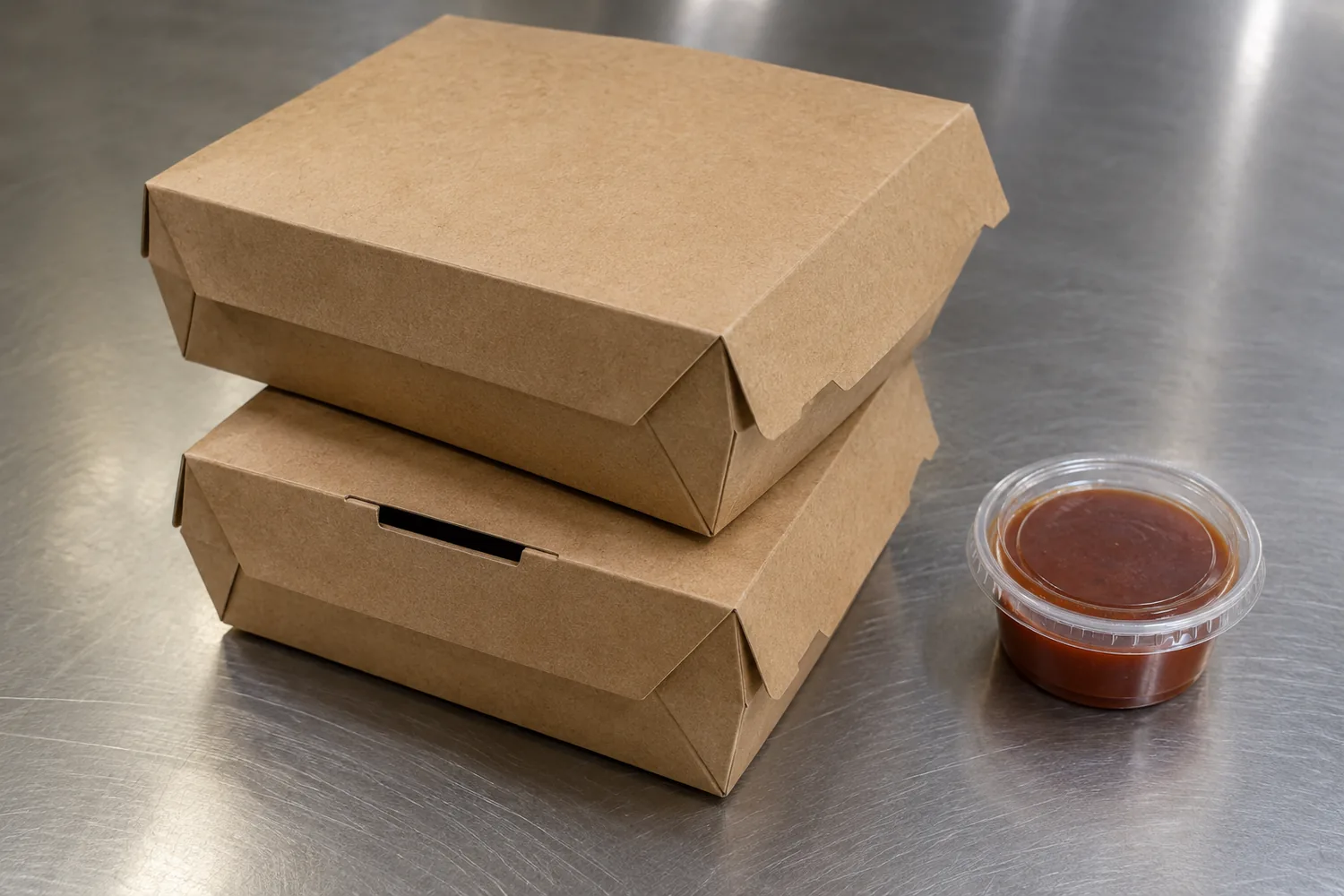
For crisp food, compare the intended vented configuration under the actual stack. For steamed food, start from a configuration intended to retain the dish’s moisture, then assess unwanted surface wetting at arrival. For a mixed meal, keep sauce away from the crisp component; a separate closed sauce cup may be a more useful change than opening the entire meal pack.
Genpak distinguishes permanent lid holes from optional vent tabs and describes selective venting over an individual compartment. (Genpak, Why Vented Food Packaging Matters, accessed October 19, 2026.)
Use the openings designed into the product. Check that another box, a liner, or the surrounding bag has not obstructed the route. More open area is not automatically the right answer: compare the desired crust, moist interior and heat retention together, without treating a texture check as a food-safety assessment.
Does the filled box leave enough lid clearance?
Reject a box that presses the lid into the food before judging its venting. Clearance is a geometric check; it cannot predict airflow or arrival quality by itself.
Rules-of-Thumb: If clearance g < 0 mm under the intended filled and stacked configuration → choose a deeper pack or change the portion arrangement, because the food occupies space needed by the closed lid. At g = 0 mm, there is contact and no allowance for movement. A positive gap still requires checking that the vent route stays open.
Use consistent measurement reference points:
Lid clearance g (mm) = closed inner lid height H (mm) − packed-food height h (mm)
Worked example — assumptions: Assume the closed inner lid height, measured from the food-supporting base at the relevant location, is 55 mm. Assume the packed food reaches 48 mm at that location. Then g = 55 − 48 = 7 mm. That assumed pack has positive geometric clearance; the calculation establishes neither an adequate vent gap nor a verified delivery result. Check the highest food points and repeat with the intended stack resting on the lid.
Do not substitute an exterior catalogue height for H. Hinges, domed areas, ribs and the food’s position change the usable interior.
What belongs in the packaging lifecycle check?
Include the box, matching lid, liner, sauce cup, packing effort, storage and remakes when comparing the operating burden. A pack that needs extra handling or frequent replacement consumes more than the container taken from the shelf.
| Lifecycle stage | Record from your operation | Decision it supports |
|---|---|---|
| Receiving and storage | Exact base/lid codes, carton space and damaged packs | Whether staff can keep the correct combination available |
| Packing | Liners and cups used, closure effort and portion arrangement | Whether the pack can be assembled consistently |
| Pickup and transport | Wait, bag arrangement, stack and observed movement | Whether the journey reproduces the intended vent and closure conditions |
| Arrival and recovery | Wetting, escaped sauce, lid contact, texture and any remake | Which failure location requires a change |
| End of use | Actual local collection acceptance for the finished construction | How to describe disposal without assuming all paper or plastic is accepted |
Compare the complete packaging spend and packing time per fulfilled order, and record remakes separately so their ingredients and labor are visible. Keep time and money in separate columns until your own records supply a conversion rate.
Use the delivery menu item trial to make a keep, change or hold decision for the dish. Change a specific variable—pack depth, lining, sauce separation or intended vent configuration—and record it, so the next comparison can explain the difference.
Method and sources
This guide combines Genpak’s vent-design explanation and polypropylene product description with Huhtamaki’s lined-fiber examples, accessed October 19, 2026. Each source supports only the construction or mechanism cited beside it. The comparison table turns those distinctions into inspection questions; it does not assign universal material ratings. The clearance equation is a geometric definition, and its example inputs are explicitly assumed. Food-safety limits, appliance permissions, disposal acceptance and delivery-law conclusions are outside this comparison.
Updated October 2026.